
In December 2020, the University of Michigan's Division of Public Safety and Security warned students about sublet scams in the Facebook groups they used to find off-campus housing. Its advice fit in one line: "If you can't meet in person, see the rental or sign a lease before you pay, keep looking."
That advice hasn't gone out of date. The Federal Trade Commission's December 2025 report on rental scams describes the same pattern. A fake landlord presses for an application fee, a security deposit or first month's rent before the renter has seen the place. The FTC notes that many of the young adults who reported losing money were targeted in the Facebook groups college students use to find sublets and off-campus housing.
A housing office usually hears about it afterward, if it hears at all. Many offices can't say how many of their students are still searching in late July, or which listings those students are looking at, because the off-campus page they manage is a list of links and nothing comes back to them.
That gap is the best test of an off-campus housing platform. Before you compare feature lists, decide what you want to know in late July, and what you want students protected from. Then judge every vendor, Housr included, against that.
How do you choose an off-campus housing platform for a university?
Start with the outcomes your office is accountable for and turn each one into a question for the vendor. Then score every platform on the same five criteria: visibility, verification, data and privacy, focus, and cost and direction.
A cleaner interface is nice to have. It won't tell you much in July. What helps is knowing which students are still searching and trusting that the listings they see are real.
Why is this decision bigger than it looks?
Because most of your students live off campus. The Bipartisan Policy Center, working from the federal National Postsecondary Student Aid Study, puts the share of US undergraduates living in campus housing at about 18% as of 2020. At many schools the off-campus population is several times the size of the residence hall population, and the platform you choose is the main thing your office puts in front of those students.
The search also lands on students who are already stretched. In the Hope Center at Temple University's 2023-2024 Student Basic Needs Survey, 48% of 74,350 students said they'd experienced housing insecurity in the past year, and 14% had experienced homelessness.
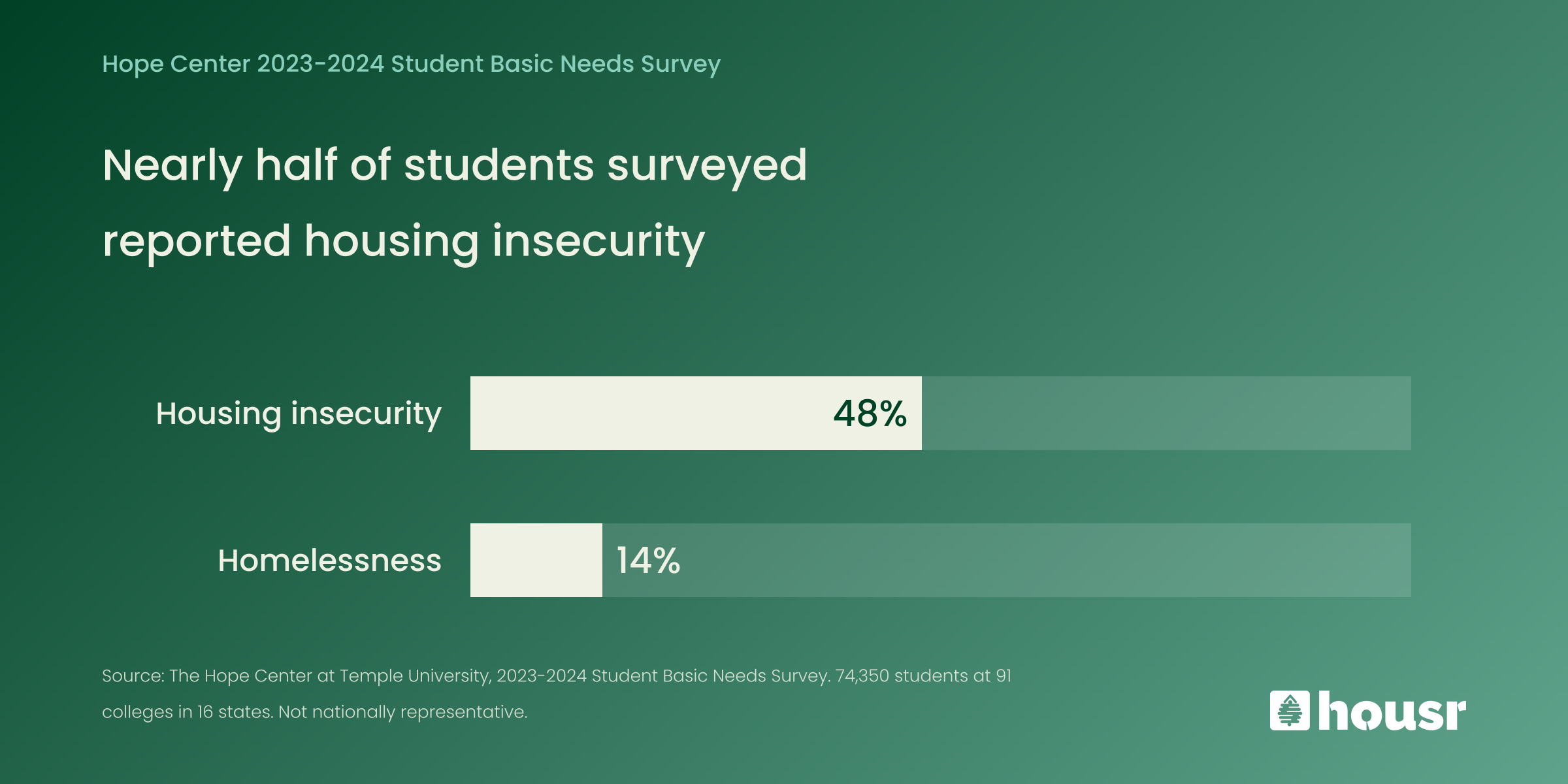
Source: The Hope Center at Temple University, 2023-2024 Student Basic Needs Survey. 74,350 students at 91 colleges in 16 states, surveyed spring 2023 to summer 2024. Schools took part through Hope Center partnerships, so results aren't a random national sample.
For a housing office, that means a bad off-campus search isn't a small inconvenience. For a student who's already struggling to cover rent, a lost deposit or a lease that falls through can decide whether they stay enrolled.
What should a university ask an off-campus housing vendor first?
Ask the vendor to show you, live, how you'd find the students who still don't have housing in July. If the answer is an export you'd have to request, or a page view count, the platform isn't built for your office.
Housing offices handle things that never show up on a feature list: the parent's call in August, the lease dispute in October, the student who can't cover a deposit, the student who moves out mid-year. A platform earns its place by making those moments rarer or easier to catch early. And at a lot of schools the off-campus work falls to one person, or part of one person's job, covering thousands of students. The platform has to do some of the watching your office can't staff for.
A five-point scorecard for any off-campus housing platform
Give each platform a 1 to 5 on every row before you sit through the demo. Then open the call with whatever scored worst. That's where you'll learn the most in the least time.
Criterion | What it means | What good looks like |
Visibility | Whether your office gets a real view of where students are in their search. | A live view of who has housing, who's still searching and who hasn't started, which you can share with your dean. |
Verification | Whether students and listings are checked before anyone makes contact. | Students verified against enrollment records, and property partners vetted before their listings go live. |
Data and privacy | How student data is handled and whether insight comes back to the school. | Written data boundaries, FERPA-aware handling and permission controls agreed before launch. |
Features | Whether off-campus housing is the product's sole focus, or does it have more student-centric features that improve engagement | Students go through the not-so-fun process of searching for housing only once a year, and the ability to use the same platform for more features that contribute to everyday student life will bring more engagement from students |
Cost and direction | What the school pays, how the vendor makes money and whose priorities shape the product. | Clear pricing, a business model you understand and a roadmap that keeps student housing at the center. |
How should an off-campus housing platform verify students and listings?
Both sides should be verified before anyone can message anyone. Ask each vendor to walk you through exactly how a student account and a listing become verified. If the answer is a staff member skimming a submission form, ask what happens on a busy week.
Rental scams are why this row carries the most weight. The Federal Trade Commission's December 2025 Data Spotlight counted nearly 65,000 rental scam reports and about $65 million in reported losses from January 2020 through June 2025, with a median loss of $1,000. People aged 18 to 29 were three times more likely than other adults to report losing money.
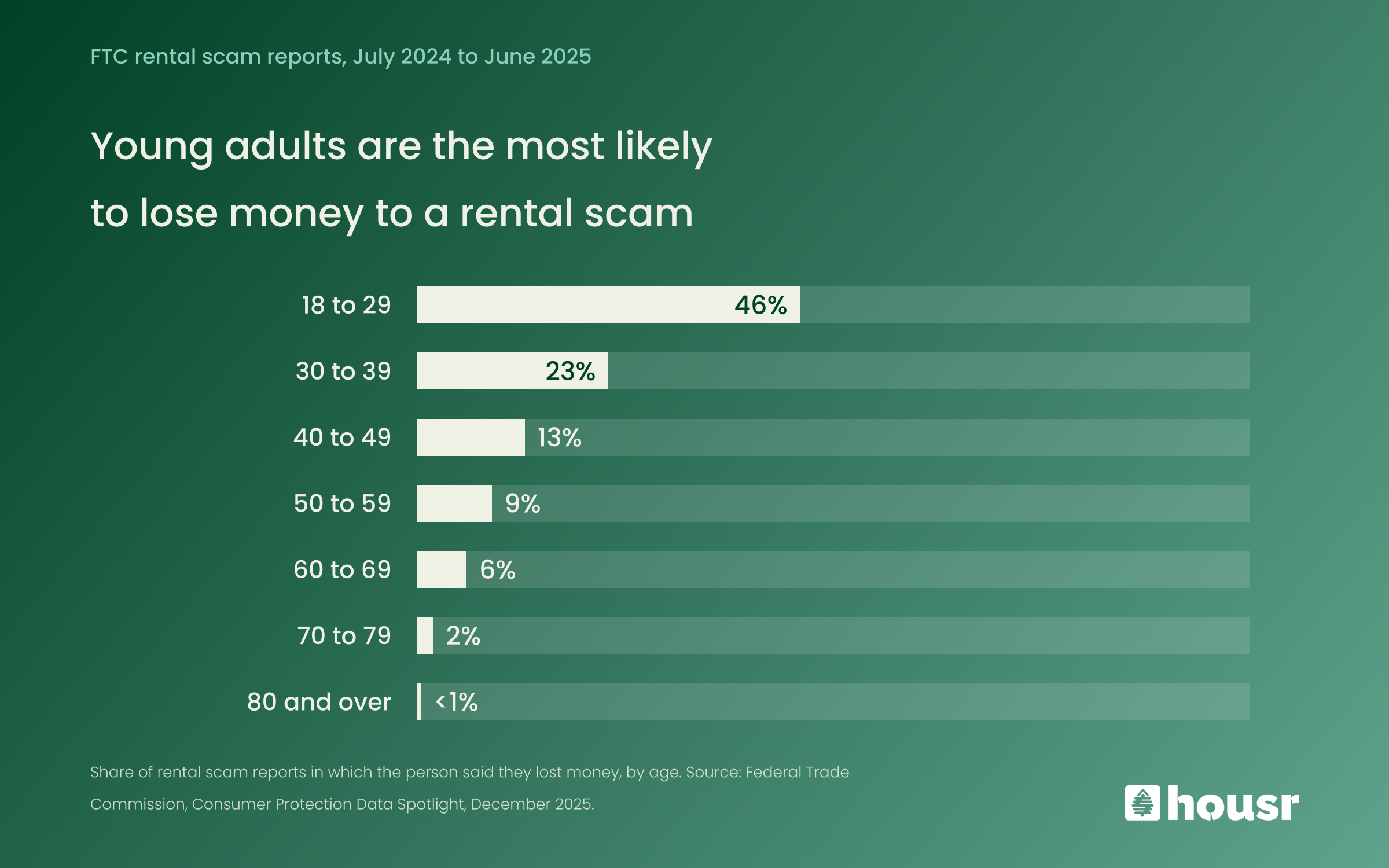
Source: Federal Trade Commission, Consumer Protection Data Spotlight, December 2025. Share of rental scam reports from July 2024 to June 2025 in which the person said they lost money, by age. Based on reports to the FTC, so it undercounts scams nobody reported.
When a student loses a deposit to a fake listing, the student takes the financial loss, but the housing office gets everything that follows. There's the emergency housing request in week one and, if the listing came through a page the school shared, the question of why. The FTC also found that about half of the people who reported a rental scam in the 12 months ending June 2025 said it started with a fake Facebook ad, so students will keep searching outside official channels whatever you buy. Share a short guide on how to vet off-campus housing and landlords alongside whichever platform you pick.
This is the problem Housr's verified off-campus housing search was built around. Every student signs in through their school's single sign-on, so 100% of users are verified enrolled students. Only vetted property partners can list, and students see verified photos and lease terms up front. Property partners like it too, because they know every applicant is a real student.
Can a university track students' off-campus housing search?
Yes, as long as the platform was built to report back to the school. A public page of listings gives students somewhere to start. Your office still won't know who signed a lease and who gave up in May.
Without that view, schools tend to manage risk with disclaimers. With it, your team can see in April which students haven't started looking and reach out while there's still time and choice, instead of finding out in July.
The Housr University Portal gives housing teams a real-time dashboard of who has secured housing, who's in progress and who hasn't started, along with landlord issues students have raised. That last part matters for accountability: you can see patterns with a property before they turn into a stack of complaints. Hold every platform you review to the same standard, and ask to see the dashboard with real data in the demo, not a mockup.
What should the platform cover besides listings?
Who students live with matters as much as where. Roommate conflict often comes back to your office as a wellbeing case or a mid-year move, so ask whether the platform helps students find compatible roommates who are also verified students. On Housr, that's Housr Roomie, our in-app roommate finder, and we point students to practical advice on living well with roommates.
Families matter too. Parents of students moving off campus for the first time have a lot of questions, and most of them end up at your front desk. Housr's Family Service gives families a 24/7 helpline with our Off-Campus Support team and a Family Portal where they can follow their student's rental journey, which gives those questions somewhere else to go.
One more call to make early: a dedicated off-campus platform, or an add-on to the residential software you already run? The add-on is often easier to get through procurement. A dedicated tool usually spends more of its roadmap on the students who live off campus. It depends which of those problems keeps your team up at night.
What does an off-campus housing platform cost a university?
Sometimes nothing at all to start. Housr, for one, costs a school nothing to launch, and partner schools get a revenue share back. So the sticker price won't tell you much. The better question is how the vendor gets paid, since that's what the product will chase for the next three or four years of your contract.
When two platforms tie on price, let the other four rows break the tie.
Before you sign
Use the five scores as your sign-off document. If a platform scores low on verification and visibility, strong marks on the other three rows won't make up for it.
Take the filled-in scorecard to whoever signs off. Your VP of student affairs might care most about visibility while the dean of students worries more about scams, and having both views on one sheet saves a lot of back and forth. Keep it, too. When renewal comes around, it's the list you hold the vendor to. For the student side of the search, our guide on off-campus student safety is a useful companion to share with your team.
If you'd like to see what verified, visible off-campus housing looks like at a school like yours, talk to our team.
Frequently asked questions
What questions belong in an off-campus housing platform RFP?
Cover verification of students and listings, the live view your office gets, where student data is stored and who can see it under FERPA, the vendor's business model, and who picks up the phone for a family at 10 p.m. Then make them prove each answer in a demo instead of a slide.
Is an approved landlord list enough on its own?
It helps, but only so far. A list tells students which landlords your office knows. It won't tell you that a sophomore is still couch-surfing in September, or that three students hit the same broken lease clause. Plenty of schools keep the list and put a platform next to it.
Who should sit on the buying committee?
Whoever actually answers the off-campus emails should be in the room, not just told the outcome. Add a student affairs leader with budget authority, and bring IT or your privacy officer in early. Single sign-on and data sharing can hold up a launch if they come up late.
Download the Housr app
The Housr app helps you manage everything in one place. Search for your next house with friends, arrange property viewings and chat to landlords directly.
We also send exclusive promotions and events to our student community via the Housr app, giving you plenty of opportunity to get freebies and save cash at uni.


