
At both private and public four-year colleges, about half of all undergraduates (between 43.8% and 52.3%) live off campus and not with their parents, according to an AACC analysis of federal student data.
Those students live in housing your institution doesn't own or operate, and mostly can't see. But the consequences are ultimately felt by your institution, because research has found a statistically significant link between housing insecurity and whether students persist, earn credits, and graduate. It also shapes how students and families talk about the school.
This guide lays out a six-part plan for keeping off-campus students safe. It works at a large university with an off-campus team or a small college where one person wears several hats. Most of it runs on structure and staff attention, and each part maps to standards leadership already recognizes.
Students living off-campus are your biggest blind spot
A student who can't find a place to live, or who loses $1,000 to a fake listing, doesn't experience it as a problem with the local rental market. They experience it as part of college itself. It's the stress they carry into their first day at school. It's the reason they skip class to rush back home to fix a problem that shouldn't have happened in the first place. And it's what they tell their parents about on the phone that night.
In fact, most students will never share this with you directly. In the Hope Center's most recent national survey, 48% of students reported housing insecurity in the past year, and fewer than half of the students struggling with food or housing used any campus support. They sleep on a friend's couch, sign a bad lease out of panic, or quietly fall behind.
But when a year off campus goes badly, the story they tell their friends and a younger sibling who's deciding to pick a school right now is that the school didn't help, even though you were never given the opportunity to.
This is exactly why you need to get ahead of the problem before it happens.
The Fix: A 6-part off-campus student safety plan
Here's a 6-part framework you can adopt to ensure student safety is maintained, at a glance.
Part | The risk it addresses | Action item for your team |
|---|---|---|
1. Visibility | Problems your office doesn't hear about until it's too late | Track 2-4 data points that help you understand issues that off-campus students are facing. For example: The share of students with confirmed housing 30 days before classes start, students without a confirmed address 15 days after classes commence, open landlord complaints, and addresses where the same issue is reported more than once. Start with what your listing board, dean of students, or conduct records already hold, or use a tool like Housr's University Insights Portal. |
2. Safer search | Fake listings and scam ads, which often start in Facebook groups students use to find housing | Share the FTC's rental listing scams guide for red flags, and point students to a verified listing service. Publish two rules at every touchpoint to students: Never wire money, and never pay before signing a lease and touring with the landlord or their agent. |
3. Education | Signing a lease they don't understand | Ship a renter checklist covering deposit terms, lease length and break fees, who handles repairs, and scam red flags. Seed it with Housr's apartment checklist, add your state's tenant rights guide (often published by the attorney general or legal aid), and put it in orientation and move-out emails. |
4. Fire safety | Units without working smoke alarms or a safe way out | Publish a two-minute tour checklist: Alarms on every level and in every bedroom, sprinklers, two ways out, and windows that open. Pull student-ready materials from CCFS's Campus Fire Safety for Students and NFPA, and push them hardest during September's Campus Fire Safety Month, when fatal campus housing fires tend to peak. |
5. Compliance | Not knowing which off-campus homes you're responsible for | Build a one-page inventory tagging each arrangement: Institution-owned or leased, controlled by a recognized student organization (like a chapter house), or private. United Educators' guide to taking inventory of off-campus real estate shows where to start. |
6. Support | Students facing a housing crisis alone | Set up one place to get help, like a shared inbox and a short form, with a named person behind it. Respond the same day to safety problems and scams in progress, and publish a response time you can meet for everything else. Include ReportFraud.ftc.gov and ic3.gov so scam victims can report right away. |
Here's a deeper dive into the six phases mentioned above.
1. Visibility: Know Where Your Students Stand
You can't help a student without understanding what they're going through right now. Decide which data points your office should be able to read at any moment, then find where each one lives today. A workable starting set:
The share of students who've secured housing
Students who haven't started a search
Open landlord issues
Properties where tenants generate repeat complaints
Most offices find these numbers live nowhere. That's why nobody can connect a student's housing situation to whether they'll stay enrolled.
Housr's university insights portal was built for this gap. For students searching through Housr, your office can see who's secured housing and who's still looking, open landlord issues, and early flags on properties that draw repeat complaints. Data handling follows a clear policy, and audit logs are exportable.
2. Safer Search: Steer Students Toward Verified Listings
Where a student searches decides how safe they are. Open classifieds and social groups let anyone post anything. A verified platform confirms who controls a unit before the listing goes live.
The FTC data shows where scams start. Among people who reported a rental scam in the 12 months ending June 2025 and named a platform, about half said it began with a fake Facebook ad. Many young adults told the FTC they were targeted in the Facebook groups college students use to find sublets near campus. Since 2020, consumers have reported nearly 65,000 rental scams and about $65 million in losses, with a median loss of $1,000.
Give students two rules that shut down the most common scams:
Never wire money.
Never pay anything until you've signed a lease and toured the unit with the landlord or their agent. A self-guided lockbox tour doesn't count, since scammers copy listings from self-tour services. If you can't get there in person, ask for a live video walkthrough led by the landlord, and search the address online to see if it's listed elsewhere at a different price.
Housr's verified off-campus listings cut the risk of fake listings on one side. At partner universities, SSO login means every applicant is a confirmed, enrolled student, so landlords aren't dealing with anonymous accounts either. If a dispute comes up, a three-way chat between the student, the landlord, and your office gives the student support and gives you a way in.
3. Education: Teach Students Before They Sign
Education is the cheapest part of the plan, and it reaches students before they sign anything. This term, ship one renter checklist and one way to report a scam. Then put both where students already are: Orientation, the housing portal, move-out emails, RA training, and international student services.
Keep it practical. Cover lease commitments and deposit terms, the red flags of a fake listing, and a single path to report a problem. This student apartment safety checklist can seed the lease and safety sections so your team isn't writing from scratch.
Bring parents in too. When families can follow the search, they can see the school is paying attention. Give them a way to follow the search alongside their student.
4. Fire Safety: Give Students a Two-Minute Tour Checklist
The Center for Campus Fire Safety tracks student fire deaths using news reports. From January 2000 through its last update in April 2022, it documented 94 fatal fires that killed 134 students. Eighty of those fires, and 114 of the deaths, happened in off-campus housing within three miles of campus. Residence halls and Greek housing accounted for 10 deaths each.
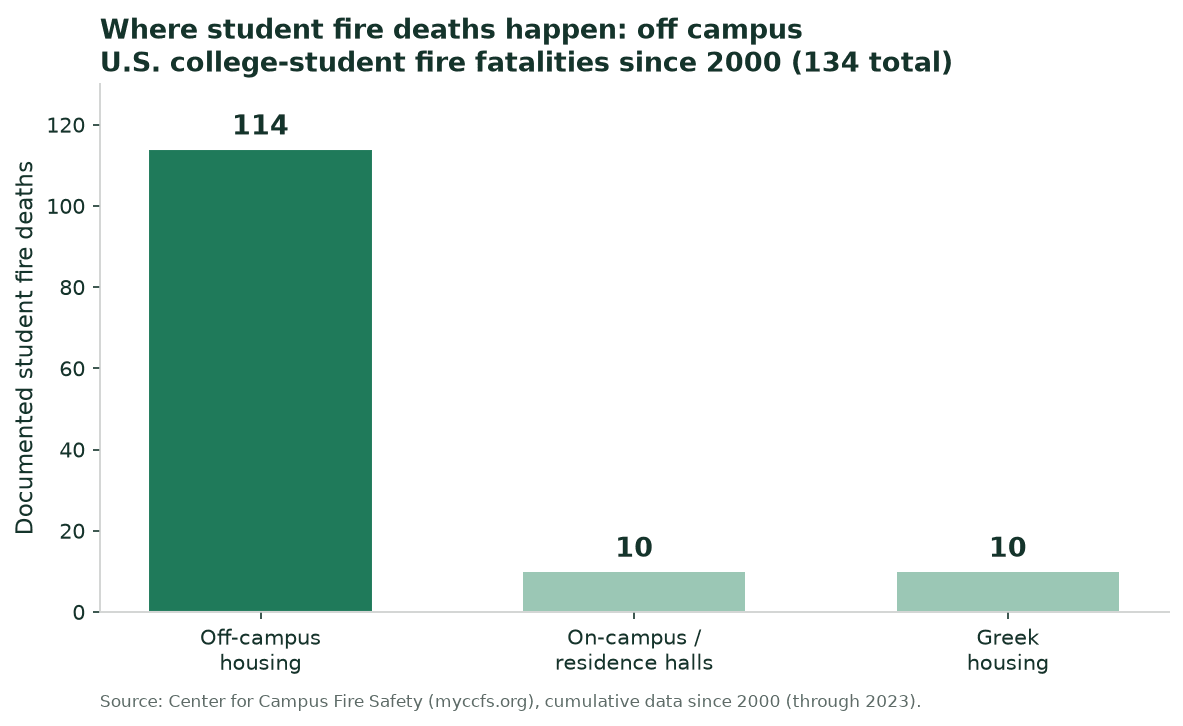
Source: Center for Campus Fire Safety, cumulative data from January 2000 to April 2022.
A U.S. Fire Administration review of 85 fatal campus fires between 2000 and 2015 found smoke alarms were missing or disabled in 58 percent of them. None had sprinklers.
Publish a checklist students can run during a tour. It should fit on a phone and take two minutes. Four checks:
A working smoke alarm on every level and in every bedroom
Sprinklers, where the building has them
Two ways out of every bedroom
Exits and windows that aren't blocked or painted shut
A unit that fails on alarms or exits is a walk-away, before anyone talks about a deposit. Students touring by video can run the same checklist by asking the landlord to point the camera at each alarm and exit. Push the checklist hardest during leasing season, when students are touring.
5. Compliance: Know Which Off-Campus Homes You're Responsible For
Some off-campus housing is legally your institution's responsibility, and the students living there are counting on you to know which. Build a one-page inventory that tags each arrangement as owned or controlled by the institution, controlled by a recognized student organization, or neither. That tag decides your Clery reporting and your duties as a landlord. Route every new agreement through counsel, or your insurer's risk team, before anyone signs.
Under the Clery Act (34 CFR 668.46), noncampus property covers two things: Buildings owned or controlled by a student organization your institution officially recognizes, such as many fraternity and sorority houses, and property your institution owns or controls away from campus that's used for institutional purposes and frequently used by students. "Control" includes leases and other written agreements, even informal ones like an email. Apartments students rent on their own generally fall outside Clery.
If your institution leases, subleases, or master-leases any off-campus units, United Educators' landlord guidance (September 2026) is the checklist for those properties: Counsel-reviewed leases, an accountable office for each property, a central file of every contract, and written agreements with any third-party manager.
6. Support: Give Students One Place to Get Help
When students don't know where to turn, a landlord dispute or a lost deposit can snowball into losing their housing. Set up one place for off-campus housing problems and scam reports. At a small school, a shared inbox and a simple form are enough. Give it a documented escalation path, and review what comes in every month.
One channel gives students a known place to raise a landlord dispute or flag a suspected scam. It lets your office step in before things get worse. And it builds the record that feeds your visibility data in Part 1. For confirmed scams, point students to the FTC at ReportFraud.ftc.gov and the FBI's Internet Crime Complaint Center at ic3.gov. Their report helps protect the next tenant.
Roommate conflict belongs here too. It's one of the quieter ways a student ends up without a place to live, and sometimes without a reason to stay enrolled. Pair the channel with shared-living guidance so a dispute has somewhere to go early.
Where to Start This Term
Here's the shift the plan makes.
Earlier, when you heard about a bad landlord, you had no way to say how many students have housing, and are forced to answer safety questions with a disclaimer that this is not the university's responsibility.
Now, you can see where students stand and exactly which properties are reported to have repeat issues, route them to verified listings, and point to a documented plan.
Getting there takes structure and attention more than money. Pick the two parts where your campus has the widest gap and commit to one concrete step on each before the term ends. The next time someone asks what you're doing to keep off-campus students safe, you'll have an answer and the records to back it up.
See Where Your Off-Campus Students Stand
Housr gives housing offices visibility into where students are in their off-campus search, with verified listings and a direct line to landlords when something goes wrong. See how the university portal works today.
Want students starting their search somewhere safer? Share the Housr app in your next housing email.
FAQ
How can universities keep off-campus students safe?
Start by giving students one point person and one place to get help, then close the biggest gaps: Steer them toward verified listings, teach them the scam red flags before they sign, and give them a fire-safety checklist for tours. Concrete step: Pick the two parts of this plan where your campus is weakest and take one step on each this term.
Does the Clery Act apply to off-campus housing?
In specific cases. Clery's noncampus category covers two kinds of property: Buildings owned or controlled by a student organization your institution officially recognizes, such as many fraternity and sorority houses, and property your institution owns or controls away from campus that's used for institutional purposes and frequently used by students. Institution-owned housing within the campus area counts as on-campus instead. "Control" includes leases and other written agreements, even informal ones like an email. Apartments students rent on their own generally fall outside Clery. Concrete step: Build a one-page inventory tagging each arrangement and route it past counsel.
What's the most effective way to protect students from rental scams?
Move them off open marketplaces. The FTC (December 2025) traced about half of platform-identified rental scams in the year ending June 2025 to a fake Facebook ad, and found adults ages 18 to 29 three times more likely than others to lose money to one. Concrete step: Publish two rules at every housing touchpoint: Never wire money, and never pay before signing a lease and touring with the landlord or their agent, in person or by live video.
How can students check an off-campus apartment for fire safety?
Start with alarms and sprinklers. A U.S. Fire Administration review of fatal campus fires from 2000 to 2015 found smoke alarms missing or disabled in 58 percent of them, and none had sprinklers. Concrete step: Give students a two-minute tour checklist covering working alarms on every level and in every bedroom, sprinklers where the building has them, two ways out of each bedroom, and windows that open.
What should we do when campus housing is full?
Treat overflow as a safety problem. When halls fill up, more students hit the private market at once, often late in the leasing cycle, and those are the students you can see least. Concrete step: Point overflow students to a verified inventory and a single place to get help from day one, so a shortage of beds doesn't turn into a scam or safety problem.
Download the Housr app
The Housr app helps you manage everything in one place. Search for your next house with friends, arrange property viewings and chat to landlords directly.
We also send exclusive promotions and events to our student community via the Housr app, giving you plenty of opportunity to get freebies and save cash at uni.


