
If you’re a housing and residence life leader, the off-campus properties you recommend to your students or list on your website directly impacts students’ experience and life once they leave the residence halls.
It’s important to remember that off-campus listings can’t just be built on personal relationships with housing developers and property management companies.
This piece emphasizes on why vetting off-campus housing and property listings is incredibly important, and provides a six-step vetting standard you can adopt, along with a way to enforce it.
The implications of students picking bad off-campus properties
In a 2025 survey by the Federal Trade Commission, the FTC reported that people between ages 18 to 29 were three times more likely than other adults to report losing money to a rental scam, and that group accounts for 46% of loss reports between July 2024 and June 2025.
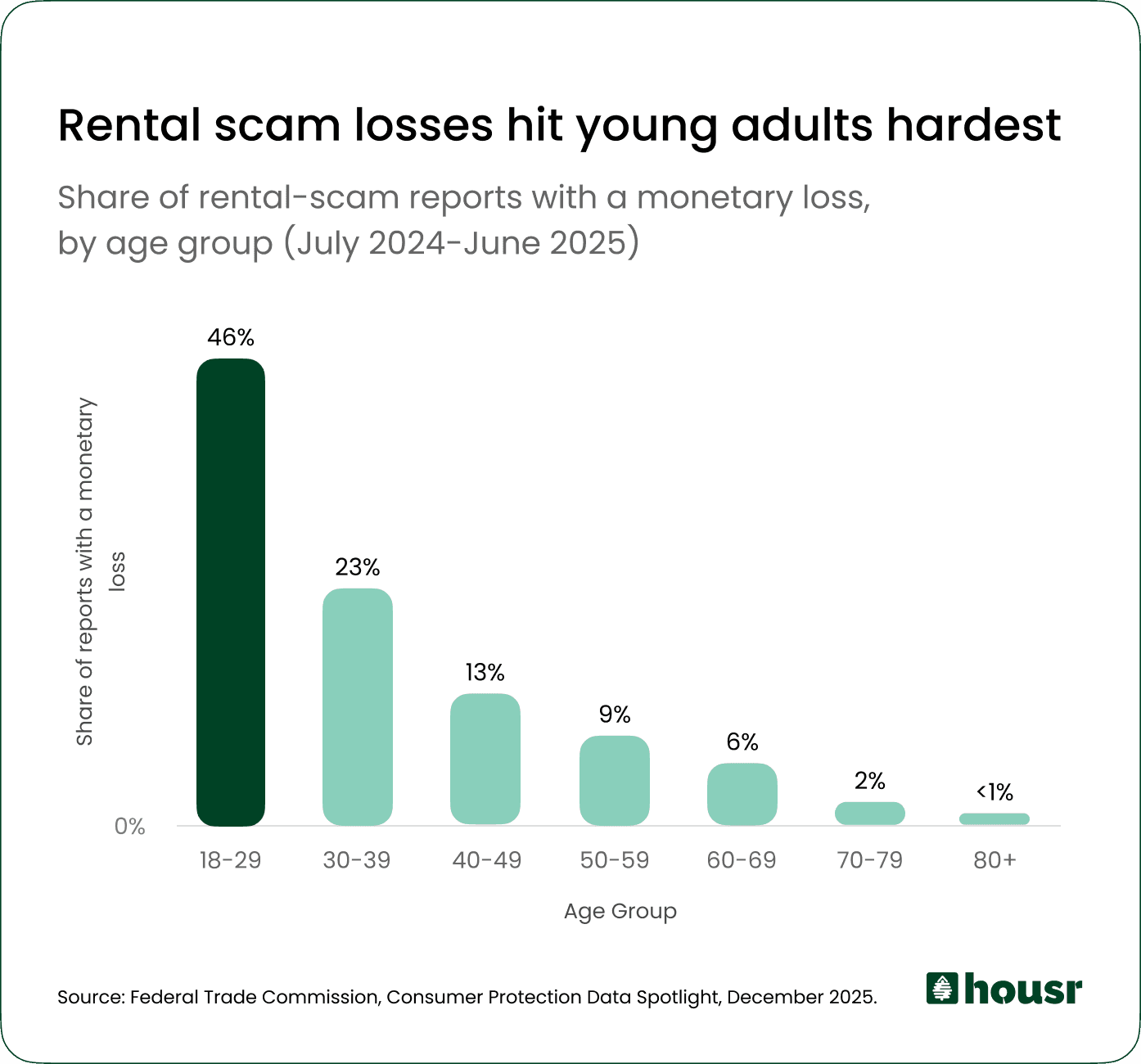
Source: Federal Trade Commission, Consumer Protection Data Spotlight, December 2025.
A good portion of that age-group includes college students. Almost 60% of undergraduates live off-campus, and an unvetted list of off-campus housing and landlords transfers that fraud and habitability risk onto students. That inevitably gets attributed back to the institution when something goes wrong by parents or the press, even though most university websites will expressly state that a listing isn't an endorsement to avoid legal implications.

An example of a university website mentioning that the properties listed on their website are not inspected by themselves or their partners
Inclusion should mean something verifiable. For example, Housr only includes vetted properties so students at universities that have partnered with Housr can rely on the app to find verified listings. This consolidates fragmented property searches into one streamlined experience, helping students avoid questionable platforms like Facebook Marketplace or Craigslist to find off-campus housing.
There are three things every Director of Housing & Residence Life and university housing team can keep in mind to solve this for their students:
Treat every listing as a fraud vector until it is verified, and never publish a landlord you have not confirmed owns or manages the property. Rental fraud is large, and it concentrates on the exact demographic your office serves. According to FTC rental scam data, since 2020, people have reported nearly 65,000 rental scams to the FTC with about $65 million in losses. The median reported loss is $1,000, and the FTC notes these figures are likely under-reported, so the real exposure runs higher.
Remember that students treat a university-referred list as the safe alternative to the fake ads or shady listings where these scams begin. That trust is exactly what the list has to earn, and it is lost the first time a listed landlord turns out to be a fraud.
Add housing security and habitability, not only price and proximity, to the criteria your list is judged on. Unsafe or insecure off-campus housing connects directly to the outcomes directors are measured on, so vetting is a retention lever as much as a fraud filter.
Here's why this matters:
Bad housing is a retention problem, not just a housing problem
The Hope Center basic needs survey for 2023-24 found that among 74,350 students at 91 institutions across 16 states, 48% reported housing insecurity and 14% reported homelessness. That is not a US national rate, but it describes a large surveyed population and a problem that lands on your desk.
The same Hope Center research ties housing security to persistence. Among students who had stopped out or were considering it, 79% cited basic needs insecurity or financial reasons. The direction of the relationship is what matters for planning: the students most exposed to a bad off-campus lease are often the ones already closest to leaving.
Framed as equity of access, vetting becomes a way to protect students who have the least room to absorb a lost deposit or an uninhabitable unit. A first-generation student who wires a deposit to a fake landlord does not simply lose money. That student loses the housing stability that makes finishing the term possible.
Visibility into where and how students live off-campus is what lets an office act before a housing problem becomes a withdrawal, which is why the enforcement mechanism in the next section matters as much as the standard itself.
A six-step standard for vetting off-campus landlords
Adopt these six steps as your written vetting policy. The checklist is the deliverable, and it works for any list your institution publishes or refers students toward.
Verify legal ownership. Confirm the landlord against county property records before the listing goes live, so you never refer a party who does not own or manage the property.
Confirm identity and licensing. Check the landlord's identity and any rental license or registration the jurisdiction requires. One model for how properties get verified has every inquiry and lease request verified directly with the institution.
Set written baseline conditions. Define habitability standards and transparent lease terms in writing, and specify how deposits must be held and returned. Guidance on reviewing student lease terms gives students and staff a shared reference point.
Require a complaint and escalation path. Document how a student raises an issue and who on the landlord's side is accountable for resolving it, with a named contact.
Re-verify on a fixed cadence. Re-check ownership and licensing, along with the baseline conditions from step three, on a set schedule, and remove landlords who fail.
Log every decision. Record why each landlord was added or removed, and what evidence supported the call, so the list is auditable when a student or a general counsel asks.
The profession's own guidance supports this posture. ACUHO-I professional standards (2020 edition) state that an off-campus housing referral service, where offered, must be "operated efficiently and in a professional manner" and ensure providers "follow equal opportunity (equitable access) principles." The standard is voluntary and sets no numerical vetting criteria, which means the specifics are yours to define.
The six steps above turn that professional duty into a policy you can hand to a colleague and repeat every term. If all that sounds like a lot, you can always partner up with Housr to manage your off-campus listings and properties and provide access to every student in an Airbnb-style app.
Make the standard enforceable and auditable
Choose an enforcement model, and make sure whatever you pick logs verification and keeps a complaint trail, then re-checks landlords on a cadence and records every decision. A static list decays the moment it is published, so a standard is only as strong as the office's ability to enforce it at listing time and monitor it afterward.
The three common models handle that responsibility very differently.
Model | Verification at listing | Ownership check | Communication trail | Issue visibility | Re-verification |
Open marketplace | None | None | Off-platform | None | None |
Manually maintained referral list | Once, when added | Manual, one-time | Off-platform (phone, email) | Only after a student complains | Ad hoc, staff-dependent |
Verified platforms like Housr | Taken care of by the vendor before a listing goes live | Verified against ownership records at onboarding | On-platform and logged | Real-time to the housing team | Scheduled, on a fixed cadence |
Housr is built as the operational answer to the enforceability problem, giving housing offices a verified off-campus housing partner rather than a directory to police by hand. Only verified Property Partners can list, so the ownership and verification gate is applied before students ever see a property. SSO verification confirms that every user is an enrolled student, which closes the door the FTC data shows scammers use most.
Landlord communication stays in the app, with an escalation path that routes student issues to the housing team, so a complaint is a logged event rather than a lost email. The University Portal surfaces landlord issues in real time under clear, compliant data boundaries, giving the office visibility it would otherwise gain only after a student was already harmed. Students, in turn, search verified rental listings where verification happened at listing time, not after the lease was signed.
Where to start before the next term begins
Run the six-step audit on your existing list this term and document the results. Pull the current list, test each landlord against the standard, remove or re-verify anything that fails, and publish a plain statement of what inclusion promises students.
The office's credibility rides on the standard behind the list. The payoff shows up in fewer scams reaching students and in safer housing for the ones who need stability most, which is the same result your retention and wellbeing goals are asking for. If you want to see how a verified partner enforces this without adding headcount, that is a low-cost first conversation to have.
Housr partners with universities to give housing teams verified off-campus listings and real-time visibility into landlord issues, under compliant data boundaries and at no cost to the institution. It supports the duty of care your office already carries, filling a gap most teams cannot staff.
Talk to our team to see how a verified partner supports your duty of care.
Download the Housr app
The Housr app helps you manage everything in one place. Search for your next house with friends, arrange property viewings and chat to landlords directly.
We also send exclusive promotions and events to our student community via the Housr app, giving you plenty of opportunity to get freebies and save cash at uni.


